The Breed
The two Rottweiler standards, point by point
Two official documents describe this breed, and on several points an owner reading both would meet two different dogs. Here is where they agree, where they part, and which text answers which question.
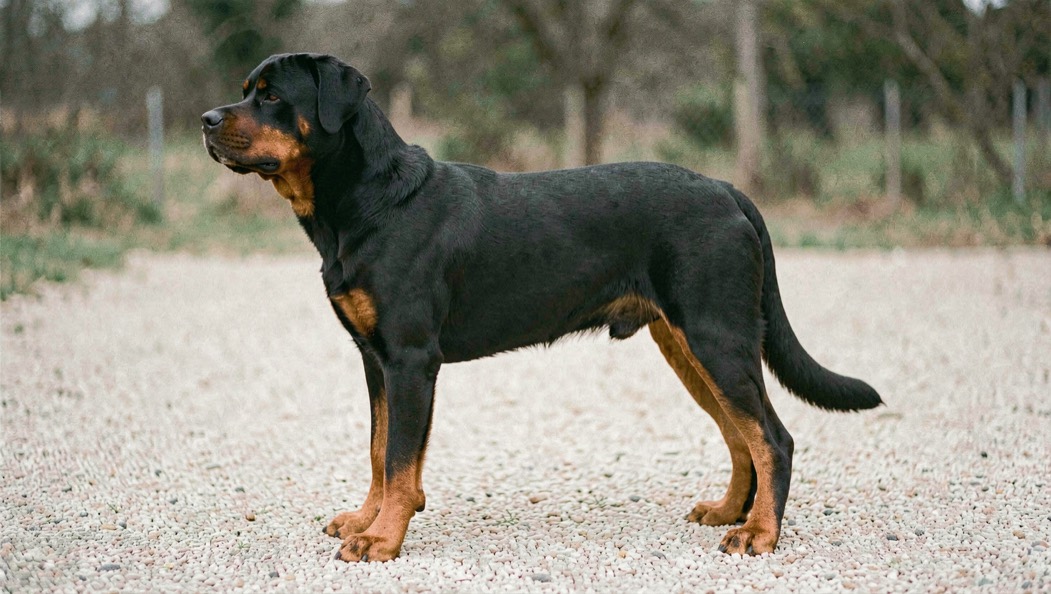
Open the two official standards side by side and the first thing that appears is not a disagreement but a difference of job. The FCI standard, number 147 in its 2018 translation, is written for a federation of continental clubs: it measures in centimetres, it sets a working trial culture around the breed, and it describes the dog in the tradition of the German original. The AKC standard is written for an American registry and a ring culture: it measures in inches, it prefers the middle of every range, and on one headline point, weight, it says nothing at all. Neither text is wrong. Each answers to a different audience, and an owner in the Carolinas meets both, because a dog imported from Europe arrives with FCI paperwork and a dog bred stateside is usually described in AKC terms.
Two documents, two jobs
The FCI standard (no. 147, 2018) puts males at 61 to 68 cm (50 kg) and females at 56 to 63 cm (about 42 kg). The AKC standard gives 24 to 27 inches for males and 22 to 25 for females, with the middle of the range preferred, and lists no weight. Read the two height ranges against each other and they describe the same animal: 61 to 68 cm is 24 to 26.7 inches, 56 to 63 cm is 22 to 24.8 inches. The difference that matters is not the arithmetic. It is that the FCI text attaches a number to mass and the AKC text deliberately does not, which is why a conversation about an overweight American Rottweiler and a conversation about a bulky show line can use the same words and mean different dogs.
The history section is shared ground. The breed’s history runs from the dogs of the Roman legions to the butcher’s dog of Rottweil, and it was recognized as a police dog in Germany in 1910. Both standards tell some version of that arc, and neither treats it as a claim about your dog’s character. It explains the body: a compact draught and guard animal, heavy for its height, with the head and the grip of a working molossoid.
| Point | FCI no. 147 (2018) | AKC standard |
|---|---|---|
| Height, male | 61 to 68 cm | 24 to 27 in, midrange preferred |
| Height, female | 56 to 63 cm | 22 to 25 in, midrange preferred |
| Weight | 50 kg male, about 42 kg female | No weight given |
| Proportions | Height to length 9 to 10, chest depth half the height, skull to muzzle 3 to 2, 42 teeth | Same ratios: 9 to 10, half, 3 to 2, 42 teeth |
| Tail | Described in its natural condition | Set matters more than length; docked and natural both described |
| Temperament | Good-natured, placid, very devoted, obedient, biddable, eager to work | Calm, confident, courageous, self assured aloof |
Height and weight: inches, centimetres and a missing figure
Height is measured at the withers, the highest point of the shoulder blades, with the dog standing square. Both texts use that convention, so the numbers translate cleanly even when the units do not. Weight is where the reader has to slow down. The FCI standard (no. 147, 2018) puts males at 61 to 68 cm (50 kg) and females at 56 to 63 cm (about 42 kg), and those mass figures are targets a continental assessor expects a dog in show condition to carry. The AKC standard gives 24 to 27 inches for males and 22 to 25 for females, with the middle of the range preferred, and lists no weight. When a veterinarian in Raleigh talks about a target weight, that number comes from condition scoring and the dog in front of her, not from the AKC text. Knowing which document your breeder, your insurer or your rescue quotes prevents a category error: the FCI weight is a standard, the AKC absence of one is also a standard.
Proportions: the nine to ten rule and the depth of chest
The ratios are the quietest and most useful part of both texts, and here the two documents agree almost word for word. Height to length as 9 is to 10, chest depth about half the height, skull to muzzle as 3 is to 2, and a full complement of 42 teeth. A dog that reads square is usually too short in body; the breed is slightly longer than tall, and the extra tenth is what carries the drive of the hindquarters. Chest depth about half the height is the ratio that protects breathing room under work: a shallower chest loses heart and lung room, a deeper one costs the shoulder its reach. The 3 to 2 head ratio is why a Rottweiler skull reads broad from any angle, and it is the feature most modified by careless breeding in either direction. The 42 teeth matter in a breed with a powerful grip: the standard counts them because a missing tooth changes how force distributes along the jaw.
The tail, and what changed in 2018
This is the point where the two standards genuinely part ways in emphasis. The FCI standard describes the tail in its natural condition. The AKC standard states that the set of the tail is more important than its length, and describes both the docked and the natural tail. For a generation of American buyers a docked tail was simply what a Rottweiler looked like; in much of Europe docking has been restricted for years, and the 2018 FCI text describes the tail the dog is born with. The practical consequence for a Carolina household is mostly photographic and partly social: a natural tail is a fast, honest signal of mood, and this magazine shows natural tails in every photograph because the moving tail is the easiest piece of body language a new owner can learn to read. Neither standard treats tail state as a value judgment on the dog, and neither should a neighbor at the vet clinic.
Temperament as the standards describe it
The FCI standard describes the breed as good-natured, placid in basic disposition, very devoted, obedient, biddable and eager to work. The AKC text answers with calm, confident and courageous, a self assured aloofness with strangers. The two lists sound different and describe one animal: devoted to its own, unimpressed by novelty, and ready to work when asked. What neither standard promises is a pet. Both texts were written for assessors, and every adjective in them is measured in a work or ring setting. A household reads those same traits as loyalty, watchfulness and a strong opinion about who opens the front door. The companion article about the household, before you get a Rottweiler, takes that translation seriously.
Which document applies to your dog
Neither, in the way law applies. A standard is a description that a registry uses for breeding and judging, not a rulebook your dog obeys or violates. What applies to you is paperwork: a dog with FCI lineage carries a pedigree graded in that system, an American bred dog usually arrives with AKC registration, and a rescued adult may carry either or neither. The grading systems behind the two worlds also meet, most visibly in hip scores, where the seven step American scale maps onto the A to E letters of the continental systems; hip and elbow grading decodes that meeting. When a standard does acquire force over your life, it is rarely the breed standard: it is an insurer’s restricted breed list or a municipal ordinance, and the law survey covers both. The breed standards answer a humbler question, and they answer it well: what this animal is supposed to be.
Common misreadings of the two texts
- A dog under the FCI height range is not a rare miniature variant; it is under the range, and its paperwork should say why.
- The AKC text does not give a weight to aim at. A target weight on a clinic card comes from condition scoring, not from the standard.
- The natural tail described by the FCI text since 2018 and the docked tail described by the AKC text are the same dog in two traditions, not two breeds.
- The disqualifications list is a ring tool. Entropion, ectropion, an undershot bite and cryptorchidism are disqualifications in the standard because they are faults of structure or health, and two of them are reasons to see a veterinarian regardless of any show career.
The two texts sit in full in the bibliography of this magazine, each with its publisher and its reading date: the primary documents. The vocabulary used above, from withers to cryptorchidism, is defined once and for all in the glossary, and the survey that opens this section frames what follows: the breed survey.
The standard rewards the kind of looking this page practices, and three notes continue it. Researching an unfamiliar breed applies the same method to a dog whose papers name a different breed entirely, carting with a Rottweiler reads the working sentences through the draft dog tradition they were written from, and reading the standard for an adult dog turns the table into a checklist for the animal already in front of you.