Training
Starting a Dog on a Load, the Draft Horse Way
Ground driving and harness work borrowed from draft horse practice: how to start a dog on a load slowly, calmly and without a wreck.
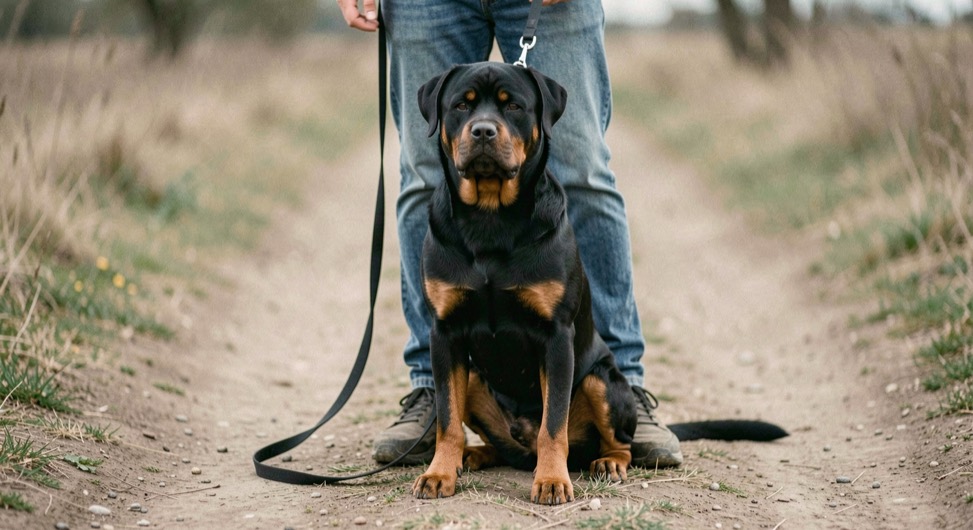
A dog can be started on a load the same way a draft horse is: on the ground, in hand, with no cart attached, until voice, line and body position mean something. The load comes last, and it comes small. Draft horse practice is useful here because it treats pulling as a trained job with a sequence, not as a strength test.
Why start on the ground instead of in harness
A horse that has never worn a collar is not hitched to a stone boat on day one. It is driven in a halter or a surcingle first, walked and trotted on a line, asked to move the hindquarters and the shoulders on cue, and taught to stand while the handler walks around it. Only then does harness go on, and only then does anything get dragged.
The same order works for a dog. Ground driving means the dog is in front of you on a long line or a pair of lines, wearing a harness but pulling nothing. You are behind, not beside. That single change of position is the whole lesson: the dog learns to move forward while someone is behind it, to hold a line, and to stop from a voice cue rather than from a leash pop.
A dog that has only ever walked on a loose leash beside a person has no idea what to do when a person is behind it and something is following. Ground driving teaches that picture before weight is added. Handlers who want to see the full progression, from in hand work to moving a real load, can study how draft horse training builds it step by step, because the sequence is the same whether the animal weighs 60 pounds or 1,800.
What equipment does a dog need for ground driving?
Less than most people buy. A well fitted harness with a broad chest and a solid back strap, a long line of 15 to 20 feet, and a flat collar for identification are enough to begin. A drag line or a light chain is added later, and only when the dog is already steady.
The harness has to fit before it has to work. The chest strap should sit low enough that it does not ride into the throat, and the girth should be snug enough that a hand can slide under it but not a fist. A harness that shifts under load teaches the dog to flinch, and flinching is hard to unteach.
Lines matter too. Two lines, one on each side, give more control than one, but they also give more to tangle. Most dogs start on a single long line run through the back ring of the harness, which keeps the pressure centered and keeps the handler from sawing on one side.
How do you teach a dog to pull without rushing?
The answer is pace work, and it is borrowed directly from driving. A horse is walked on a long rein until it holds a steady rhythm, because a horse that jigs cannot be hitched safely. A dog that bolts forward the moment it feels pressure is the same problem in a smaller package.
Start with the dog in harness and no load. Walk behind it on the line, ask for a walk, and reward the walk. If the dog surges, stop, reset, and ask again. Ten minutes of correct walking is worth more than an hour of dragging.
Then add noise and drag before weight. A short length of chain or a plastic bottle with gravel, clipped to the back ring, teaches the dog that something is following it and that the something makes noise. Most dogs accept this in two or three sessions. Some need a week.
Weight comes in small increments. A canvas bag with a few pounds of sand, then more sand, then a small tire, then a sled. The rule that draft horse handlers use applies here: if the animal has to lunge into the collar to start the load, the load is too heavy or the surface is too slick. A dog should be able to break the load loose from a standstill with a steady lean, not a jerk.
What does calm look like in a dog on a load?
Calm is not stillness. A working dog that is calm keeps its head low, its gait even, and its mouth closed. It responds to a stop cue within a step or two. It does not look back at the handler constantly, and it does not lean into the harness when nothing is behind it.
Calm is built by stopping often. In draft work, a team is halted and asked to stand several times in a session, not because it needs rest but because standing is a skill. The same holds for a dog. Stop, stand, breathe, then walk on. A dog that can stand in harness while a bicycle goes past is a dog that will not panic when a load shifts.
Calm is also built by quitting early. End the session while the dog is still walking well. The last repetition is the one the dog remembers, and a session that ends in a clean stop is worth more than one that ends in a correction.
Which surfaces and loads should a beginner avoid?
Ice, wet clay, loose gravel on a slope, and polished concrete are all bad first surfaces. A dog that slips once while pulling learns to brace, and bracing ruins a gait. Start on short grass, packed dirt, or a level gravel drive.
Avoid anything that can catch. A load with a low edge that digs in, a tire that rolls sideways, a sled with a sharp runner, all of these can jerk the harness and frighten a dog that was doing fine. A flat bottomed drag with a rounded front edge is the standard starting tool for a reason.
Avoid heat. A dog in harness works harder than a dog on a walk, and a heavy coated Rottweiler in July is not a candidate for pulling. Early morning, shade, and water breaks are not optional.
How long before a dog does real work?
There is no fixed number, but there is a fixed order: ground driving, then drag, then light load, then real load. A dog that has been walked in harness for a month, dragged a chain for two weeks, and pulled a light bag for another two weeks is usually ready for a small cart or a sled on a familiar surface.
Age matters more than enthusiasm. Growth plates in a large breed dog are not closed until somewhere between 12 and 18 months, and heavy pulling before that is a risk that no amount of talent justifies. Most working dog programs wait until the dog is physically mature, then build condition over months, not weeks.
The draft horse world is blunt about this. A young horse is not put in front of a plow to see what it can do. It is handled, driven, and conditioned, and the work comes when the body is ready. A dog on a load deserves the same patience, and the same sequence: ground first, calm always, weight last.