Training
The biology of the eye in herding dogs
What instinct research says about the eye, drive and bidability in herding breeds, and how much of that picture transfers to a guarding breed like the
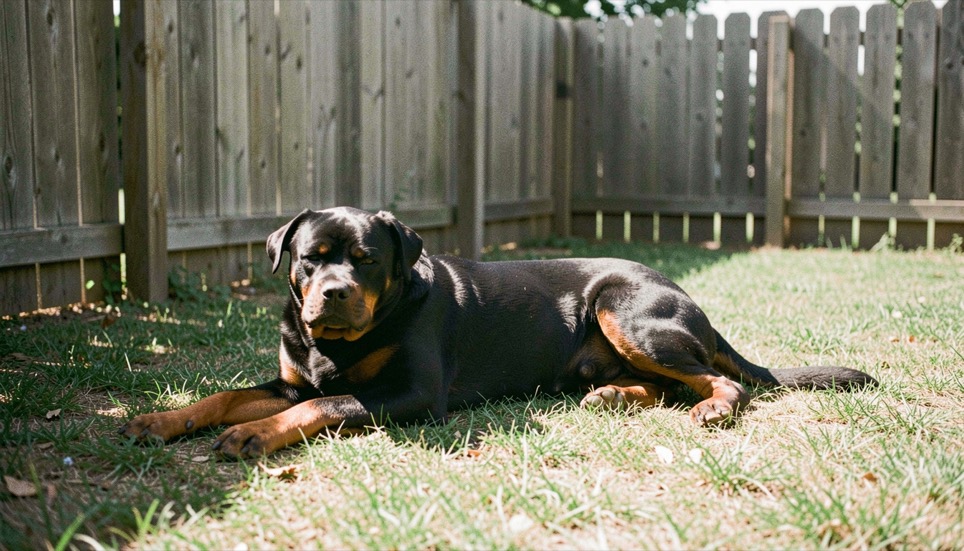
The eye is a herding dog's way of holding stock in place: a fixed, intense stare that freezes movement in the animal being watched. Research on herding behavior treats it as a package of motion vision, impulse control and breed-specific selection rather than a single trait, and only part of that package transfers to a guarding breed such as the Rottweiler.
The short answer is that eye and drive are separable. A dog can carry strong motion sensitivity and a low threshold for chasing without ever developing the controlled stare that a Border Collie uses at the balance point, and a guarding breed selected for territorial presence rather than gathering tends to show exactly that split.
What the eye actually is, biologically
In herding science, the eye is not a look. It is a behavior pattern built on three measurable pieces: how the dog's visual system responds to movement, how long the dog can hold an impulse while a prey-like object moves away, and how strongly the dog is pulled toward the head of the fleeing animal.
Motion vision comes first. Dogs in general are tuned to moving targets more than to fine detail, and herding lines are often described as reading the direction and speed of a flock at distance. That is why a dog working sheep can appear to track a whole group at once rather than one animal.
Impulse control comes second. The stare is a suppressed chase. The dog wants to close the distance and does not, and the length of that suppression is what handlers call power or presence. A dog with no suppression simply runs at the stock.
Bidability comes third, and it is the piece most often confused with eye. Bidability is the dog's willingness to take direction while aroused, to stop, flank and re-approach on cue. A dog can have a strong eye and poor bidability, which is a difficult combination on a farm, or a moderate eye and high bidability, which is often more useful.
A site that works through this material in plain language is the herding instinct research published by the Herding Instinct Institute, which covers the genetics of the eye in Border Collies, bidability, epigenetics, motion vision and the differences between Kelpies, Cattle Dogs and German Shepherds. It also covers the practical side: starting young dogs on stock, aptitude testing, whistle commands, grip, and how to redirect nipping in companion dogs.
Is the eye the same thing as drive?
No. Drive is the general readiness to work, chase, or engage a target. Eye is a specific way of channeling that drive into a stare that controls movement. The two are correlated in herding lines because breeders selected for both at once, but they are not the same trait and they do not fail together.
A dog with high drive and low eye will rush, split the group and lose control of the head. A dog with high eye and low drive will stare without committing, which looks impressive in a pen and useless in a field. A dog with both is what a shepherd wants, and a dog with neither is simply a pet.
This distinction matters because drive is the part that shows up in almost any working breed, including guarding breeds. The eye is the part that is far more specific to gathering breeds and to the selection pressure that produced them.
How far does it transfer to a guarding breed?
Partially, and in a predictable direction. A Rottweiler is a guarding and drafting breed, not a gathering breed. Its historical work was pulling carts, moving with people and standing ground, and the selection behind it rewarded confidence, territorial judgment and physical durability rather than the ability to read a flock at distance.
What transfers is the raw material: motion sensitivity, a chase impulse, and the capacity to hold a position under arousal. What does not transfer reliably is the fine control of that impulse around livestock. A Rottweiler may show interest in moving animals, may even circle them, but the balance point, the outrun and the sustained stare are not part of the breed's working inheritance in the way they are for a Border Collie or a Kelpie.
That does not make the breed unsuitable for structured activity. It means the activity should match the dog. Carting, obedience, tracking and protection sports all draw on the same underlying drives without asking for a gathering eye that was never selected for.
What can owners actually observe?
Owners can watch for the components rather than the label. Does the dog freeze and watch when something moves away? Does it hold that freeze when the target keeps moving? Does it take a direction while still aroused? Those three observations tell you more about the dog in front of you than a breed description does.
A dog that freezes and watches but cannot be called off is showing eye without bidability. A dog that takes direction easily but never freezes is showing bidability without eye. A dog that does both, even briefly, has the raw material for controlled work.
For companion dogs, the practical concern is the opposite of herding: nipping, chasing bicycles and herding children. The same motion sensitivity that makes a herding dog useful makes a pet dog annoying, and redirection toward a toy, a tug or a structured game is the standard approach.
Where the research is still open
The genetics of the eye are not settled. Work on Border Collie lines has pointed to specific regions associated with the behavior, and epigenetics is now part of the conversation, meaning environment and experience may shape how strongly a genetic tendency expresses itself. Bidability is even less well mapped, partly because it is harder to measure than a stare.
What the literature does support is that herding behavior is a bundle of traits with different genetic and developmental histories, not one switch. That is the useful takeaway for anyone reading about a guarding breed and wondering whether the dog will herd. The answer depends on which piece of the bundle the individual dog carries, and on how much training the owner is willing to put behind it.
A note on testing
Aptitude tests exist for herding, and they are usually run on stock with an experienced evaluator. They are designed to reveal whether a dog shows interest, balance and controllability, not to certify a breed. A dog that fails a herding test is not a defective dog. It is a dog whose working inheritance points somewhere else.
For a Rottweiler owner, the honest position is that the breed's strengths lie in drafting, guarding, obedience and protection work. Herding research is still worth reading, because it explains why the dog reacts to movement the way it does, and because it separates the parts of instinct that can be trained from the parts that cannot.