Adoption
Rehoming a Rottweiler
A handover treated as a documentary operation, never a moral fault, with the exact file the next home is waiting for.
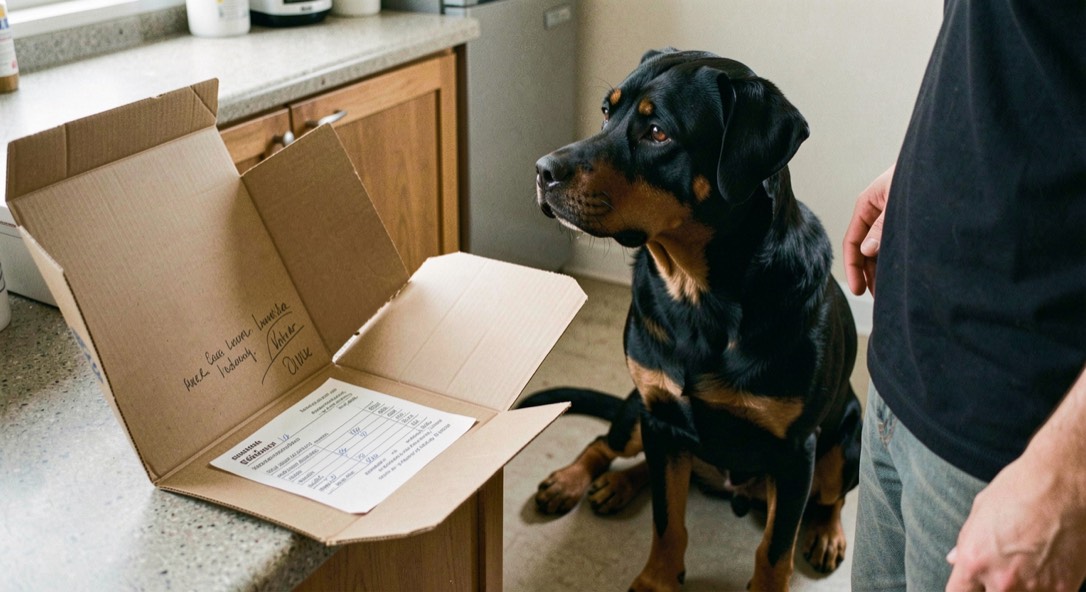
Rehoming a strong, loyal, long lived dog is usually written about as a failure, which makes most of that writing useless to the person doing it. Treat the handover as a documentary operation and the frame changes: a dog that moves between households with a complete, honest, dated file has a chance that no quantity of good intentions substitutes for. The next household can only work with what it is given, and the file is what it is given. Everything on this page serves that one object, and none of it requires a household to be anything other than plain spoken.
Timing decides more than anything else
Time is the resource that decides whether a handover is a placement. A household that starts weeks ahead can screen candidates, meet them twice and wait for the right one; a household that starts on the day the dog has to leave takes whoever appears, and everyone further down the chain knows it. The calendar below divides the work into three bands, and the honest reading of it is uncomfortable in exactly one place: nearly all of the work happens before the dog goes anywhere.
| When | What gets prepared | What gets decided |
|---|---|---|
| Weeks ahead | The record assembled, the description written, candidates screened | Whether a registered organization takes the dog or the household places it directly |
| Days ahead | Meetings run, resident animals introduced, the contract drafted | Which household, on evidence rather than on urgency |
| The day itself | The file handed over, the routine written out, the follow up agreed | The return clause, signed by everyone who will live with it |
The first band is worth dwelling on. It is where a household chooses between placing the dog itself and asking a registered organization to do it, and the choice is about capacity rather than about virtue: an organization with no foster home open this month can hold a dog no better than the household can, and a household that can hold a dog for six weeks has options that a household with a Friday deadline does not. What the organized route adds, and what it costs in patience, is the machinery described in how a breed rescue works.
The record the next home needs
The record is a folder, literal or digital, and it has six parts. The veterinary record with dates: vaccinations, heartworm testing and the preventive actually given, alterations, and anything diagnosed or treated. Identification: the microchip number and the registry it is filed under, since a chip that follows a dog without a transfer of ownership protects nobody. Screening results, where any exist, and this is where the breed’s panel matters: hips and elbows radiographed and certified, a cardiac clearance, an eye certificate, a JLPP DNA result where one was done; the screening table lists those examinations with the age at which each becomes final, which is also how a receiving household reads a folder with gaps in it. Then the food and the amounts, the words the dog knows and what each means in practice, and the dated observations of daily life that no form asks about.
Describing a dog honestly
The description is the part of the file written last and read first, and it works when it is built of behaviors. What the dog does with food, with visitors, with the doorbell, with other dogs on a walk; what it has never met, which is a different fact from what it dislikes; what it does alone for an hour; how it sleeps and where. Triggers go in with their settings, because a dog that guards a couch is a different management problem from a dog that guards a bowl, and a receiving household can plan around a fact while an adjective only asks to be argued with. The honest description has one further property worth naming: it survives contact with the dog. A household that arrives expecting the behaviors in the file finds them, and a placement that starts with no surprises is the kind that holds.
Questions worth asking a candidate home
The questions mirror the ones an applicant answers in a breed adoption, asked from the other side of the table. Who lives at the address, and what animals are already there. What the fence is like in its weakest section. What the hours alone look like on the longest day of the week. Who the veterinarian is, and what happened to the animals that came before. What the plan is when the household moves. The answers worth weighing are the specific ones, and the fastest way to get them is to ask about last Tuesday rather than about intentions in general: a candidate who describes an ordinary day in detail is describing the week the dog will actually live.
Contracts, fees and the return clause
A private handover is still a contract, and the clause that matters is the same one a registered organization uses: the return clause. A dog that cannot stay comes back to the household that wrote the file rather than to a stranger, a roadside or a classified advertisement, and agreeing on that in writing before the dog leaves is what makes the clause real rather than nominal. Money in a private placement is usually a formality, and the amount matters less than what it signals; what a participation fee covers in the organized route, and why it never equals what the dog cost, belongs to the machinery of placement rather than to the household at the kitchen table. The organized route, written for the receiving side of the exchange, is the adoption process.
What changes when the dog is old or sick
Age and illness change the arithmetic of a handover while leaving the method intact. The file grows a current section: the diagnosis, the medication and its schedule, the cost and the prognosis as the veterinarian stated them, and the quality of the days as the household actually observes them. A receiving household takes on a managed condition when it can see the size of it, and the cruelest version of this handover is the one where the file hides the schedule of care the dog is already running on. Distance changes the picture too: a move that crosses a state line adds paperwork that has nothing to do with the dog itself, and across state lines is the checklist for that trip.
The file that travels with the dog is rebuilt from fragments in tracing a dog’s record, and the household that splits rather than surrenders, where the dog lives between two addresses, is organized in the dog between two households.